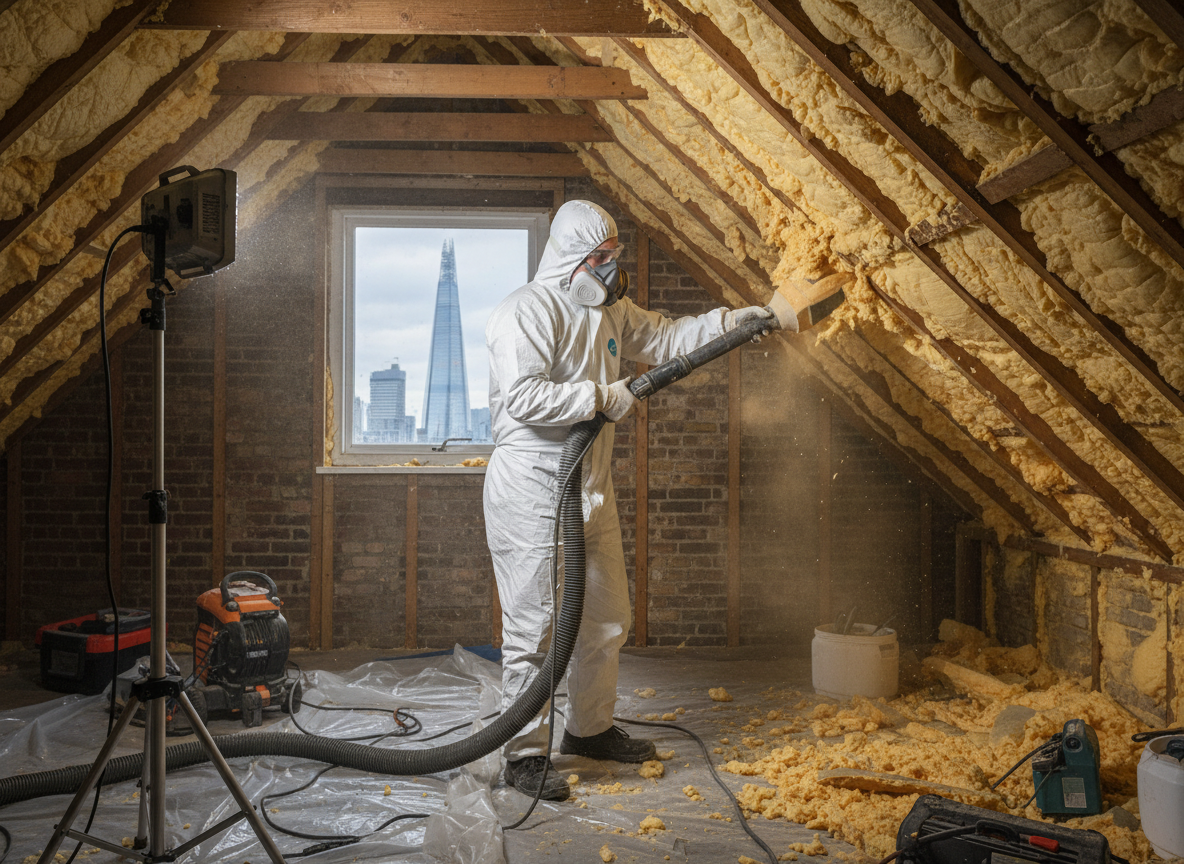
Closed cell spray foam bonds tightly to joists, rafters and masonry in London’s Victorian and Edwardian terraces, often trapping moisture against original brickwork and lath. Removal requires careful mechanical separation followed by solvent softening to avoid damaging historic timbers that have already been stressed by decades of roof leaks common in Kensington and Chelsea. Workers must also manage the dust and off-gassing that occurs when the foam is cut, especially in poorly ventilated lofts typical of W8 and surrounding postcodes.
Greater London’s mild but persistently damp winters mean many installations from the 2000s onward now show adhesion failure where condensation has sat behind the foam. Technicians routinely discover hidden rot in ceiling joists once the foam is stripped, particularly in properties near the Thames where higher humidity accelerates timber decay. Proper disposal follows Environment Agency rules for polyurethane waste, and crews must bag and label material on site before leaving the property.
Edge cases include foam applied over electrical cables or around chimney breasts in period homes; these require isolation of circuits and fire-stopping reinstatement after removal. In newer flat conversions across Greater London, foam often fills party wall cavities, demanding party-wall agreements and careful sequencing so neighbours are not disturbed during the multi-day process.
Homeowners frequently underestimate the time needed to ventilate and clean the space afterward. Residual foam particles can remain lodged in floorboards or behind skirtings, later migrating into living areas if not fully extracted.
Technician insight
In London, the thing that catches most people out with closed cell spray foam removal is how often the foam has been pumped behind original lath and plaster in Victorian terraces around Kensington. Once you start pulling it, you find the lime plaster has already started to fail from trapped moisture, and the job suddenly expands into making good ceilings that homeowners assumed were sound.
Kensington Terrace Loft
Closed cell foam had been sprayed directly onto rafters in a W8 terrace, trapping damp against the tiles. We found widespread surface mould and softened battens once the foam was removed. After stripping and disposal we treated the timber, improved ridge ventilation and left the loft ready for new insulation.
How it works
- 1
Site Assessment
Inspect loft or cavity, identify foam type and any hidden services or rot in the specific London building fabric.
- 2
Containment Setup
Seal work area with dust sheeting and negative air machines to protect adjacent rooms in terraced properties.
- 3
Mechanical Removal
Cut and peel foam in sections, softening stubborn closed cell material with approved agents while protecting timber.
- 4
Cleanup and Disposal
Vacuum residues, treat affected surfaces, bag waste and remove from site following local regulations.
- 5
Final Inspection
Check for remaining foam, moisture issues and confirm ventilation paths are clear before handover.
Pricing
Pricing varies with access difficulty, depth of foam and any timber repairs required; quotes provided after inspection.