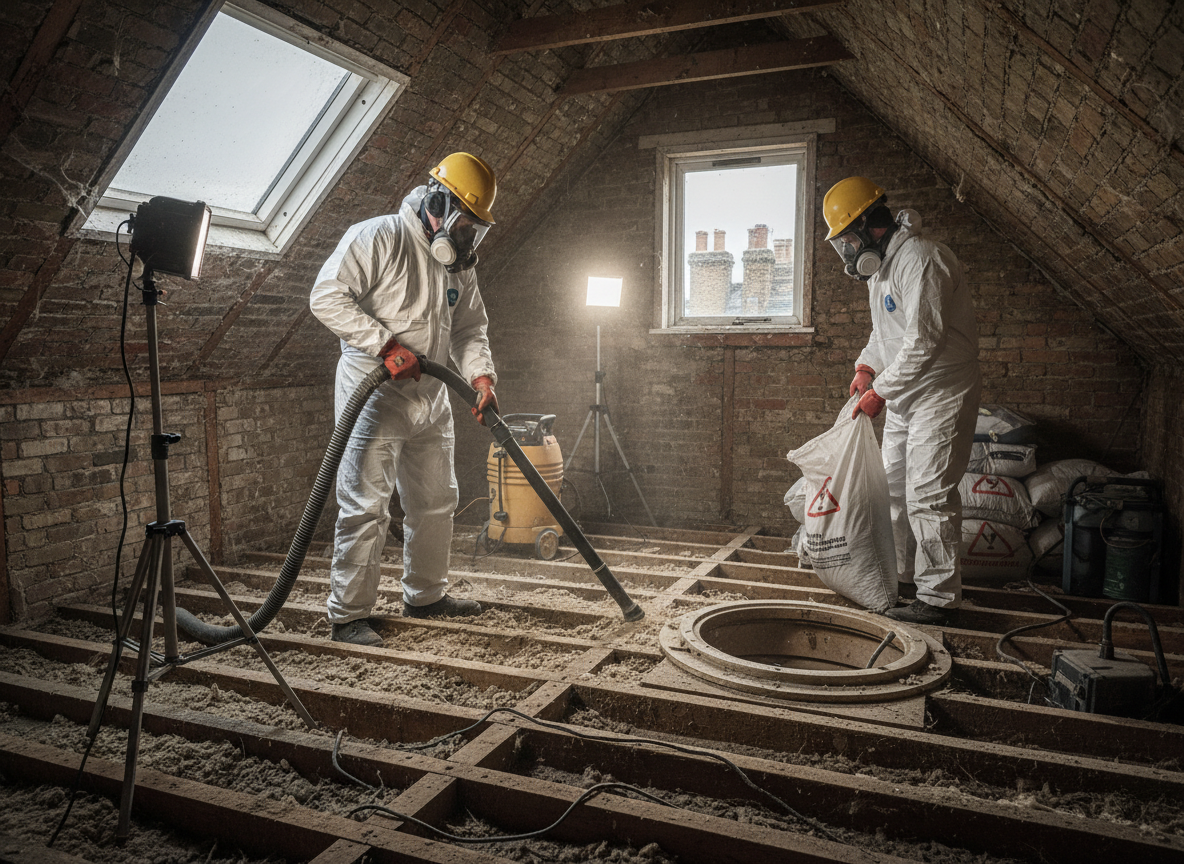
Spray foam insulation in London’s Victorian and Edwardian terraces often fails over time because solid brick walls cannot breathe, trapping moisture against timber joists and leading to rot. Removal requires careful mechanical scraping and vacuum extraction to avoid disturbing original lath and plaster ceilings common in Kensington and surrounding boroughs. Weather patterns add complexity: frequent rain and high humidity mean exposed roof voids must be dried and ventilated immediately after stripping to prevent secondary mould growth.
In Greater London stock, spray foam is frequently found in loft conversions and under eaves where access is limited by chimney stacks and party walls. Technicians must map electrical cabling and pipework first, as older installations often conceal junctions that can be damaged during foam breakdown. Post-removal inspection typically reveals whether the foam was applied over existing mineral wool, requiring layered removal to meet current building regulations on ventilation.
Edge cases arise in mews houses and basement flats around Kensington High Street where low headroom and shared drainage increase the risk of water ingress once the foam seal is broken. Proper containment sheeting and HEPA filtration are essential to stop foam particles migrating into living spaces below. Final checks include moisture meter readings on joists and recommendations for breathable alternatives suited to the area’s damp climate.
Technician insight
In London, the thing that catches most people out with insulation removal service is how spray foam in 100-year-old Kensington terraces bonds to the underside of slate roofs; once you start peeling it, the constant damp from the clay soil and poor original ventilation makes the joists swell and split if you don’t dry everything straight away.
Kensington Mews Loft
Homeowner noticed musty smells in a converted loft of a Victorian mews house off Kensington High Street. We found spray foam had been applied directly over saturated rafters. Extraction revealed hidden rot along the party wall; we removed the foam, dried the timbers, and advised on new breathable insulation to restore airflow.
How it works
- 1
Site Assessment
Inspect loft or cavity spaces, identify foam type and thickness, and check for hidden services in period properties.
- 2
Containment Setup
Install dust barriers and negative pressure systems to protect living areas in terraced houses.
- 3
Foam Extraction
Mechanically remove and vacuum spray foam while monitoring for structural timber condition.
- 4
Clearance and Drying
Remove debris, ventilate the void, and take moisture readings before handover.
Pricing
Upfront quotes after on-site inspection; cost driven by access difficulty and property age.