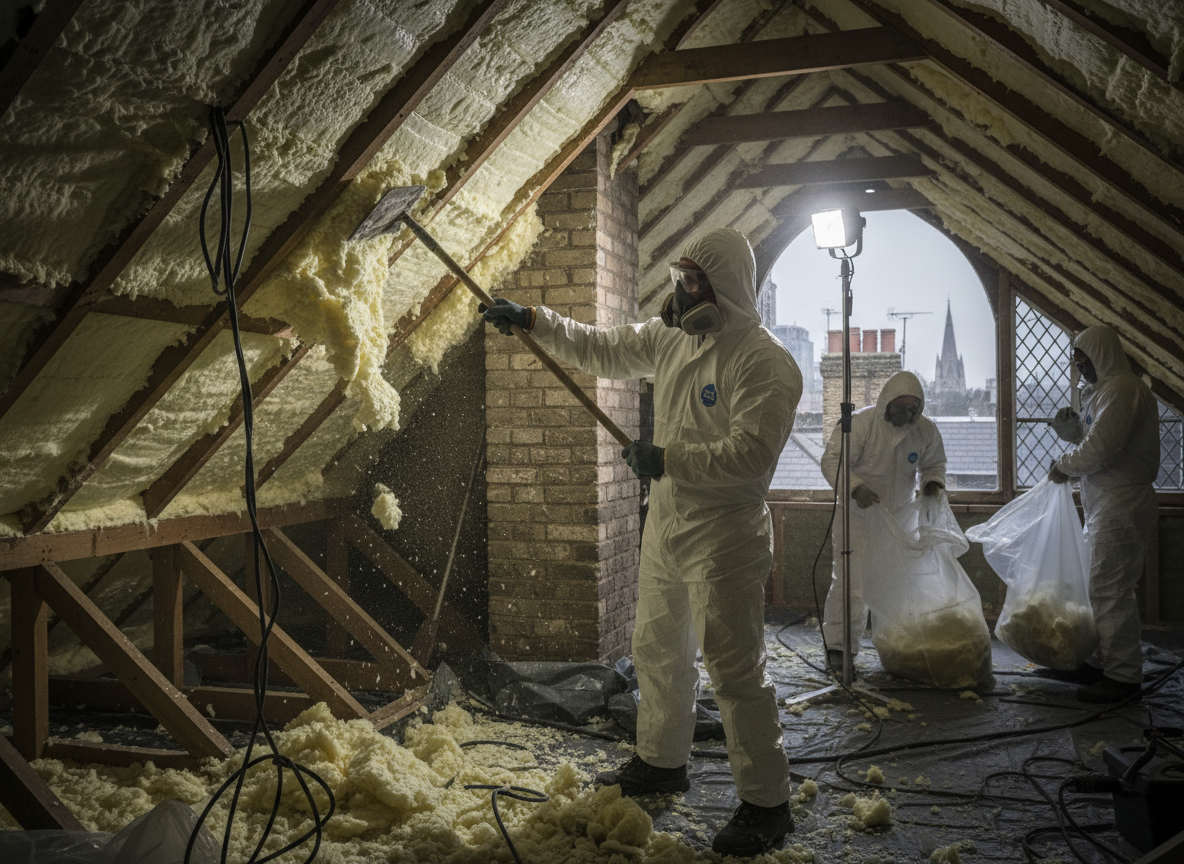
Open cell spray foam bonds tightly to timber joists and lath in Victorian and Edwardian terraces common across Kensington, Notting Hill and Hammersmith. Once moisture enters, the foam holds water against the structure, leading to rot in roof voids and party walls that receive driving rain from the prevailing westerly winds. Removal requires cutting the foam into manageable sections while protecting original plasterwork and electrical runs that run through the same cavities.
Containment is critical in these densely packed streets because dust and small foam particles travel easily through shared chimney breasts and underfloor voids into neighbouring properties. We set up negative air machines exhausting through ground-floor windows and seal all internal doors with poly sheeting before any cutting begins. In properties with suspended timber floors, we also lift boards in sequence to prevent foam fragments dropping into the void and creating hidden damp pockets later.
After the bulk material is removed, residual cells must be scraped from joist faces and brickwork. London’s high humidity means any remaining film can re-absorb moisture within weeks, so we finish with a stiff brush and HEPA vacuum followed by a borate treatment on exposed timber. Access in loft spaces is often restricted by low collars and water tanks; we work in sections, bagging material as we go to avoid overloading the ceiling below.
Technician insight
In London, the thing that catches most people out with open cell spray foam removal is how far the foam travels behind lath and plaster in 1890s terraces. Once you open a loft in Kensington you often find it has wicked into the party wall and under the eaves of the next house; if you only clear what you can see, the hidden layer stays damp and the problem returns within a year.
Kensington Terrace Loft Clearance
Open cell foam in a 1902 terrace had absorbed rainwater through a slipped slate and was holding moisture against the rafters. We found it had also crept under the floorboards into the front bedroom ceiling. After setting full containment we cut and removed the foam in sections, treated the timber and confirmed no residue remained in the shared wall cavity.
How it works
- 1
Site Assessment
Inspect roof void, wall cavities and floor voids to map foam extent and note original construction details.
- 2
Containment Setup
Install negative air and poly barriers to prevent dust migration into living spaces and neighbouring homes.
- 3
Foam Extraction
Cut and bag open cell foam in controlled sections, protecting timber, electrics and historic finishes.
- 4
Surface Cleaning and Treatment
Scrape residues, vacuum with HEPA filtration and apply timber preservative to exposed surfaces.
- 5
Final Clearance
Remove containment, dispose of waste and walk through with the client to confirm all material has gone.
Pricing
Cost depends on access difficulty, depth of foam and whether floorboards or ceilings must be lifted; we provide a written scope after inspection.